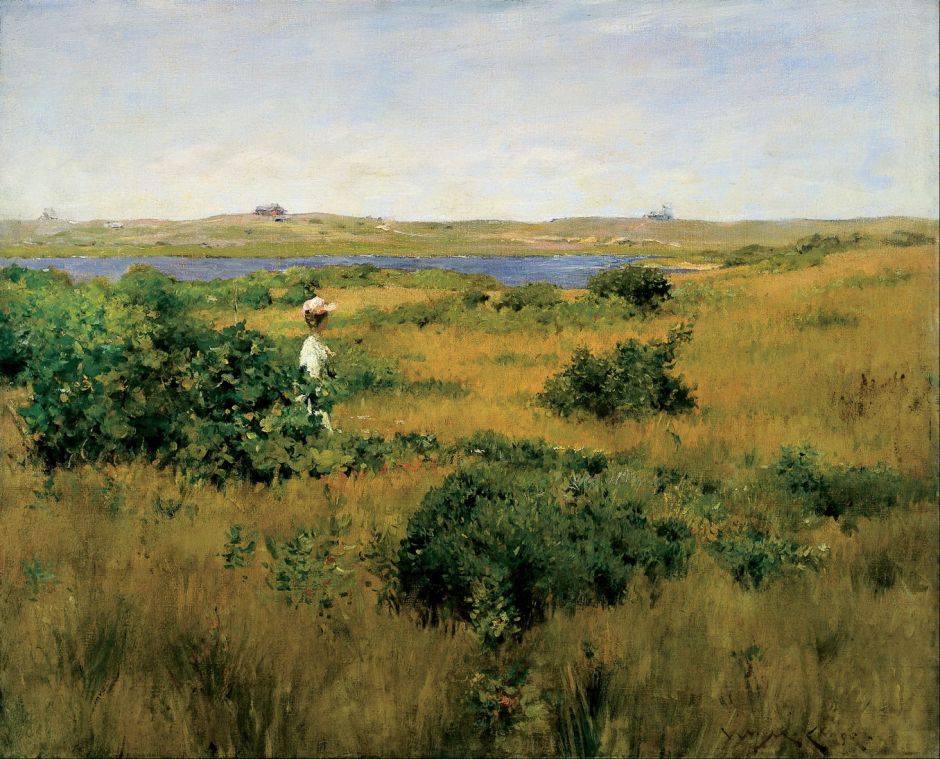
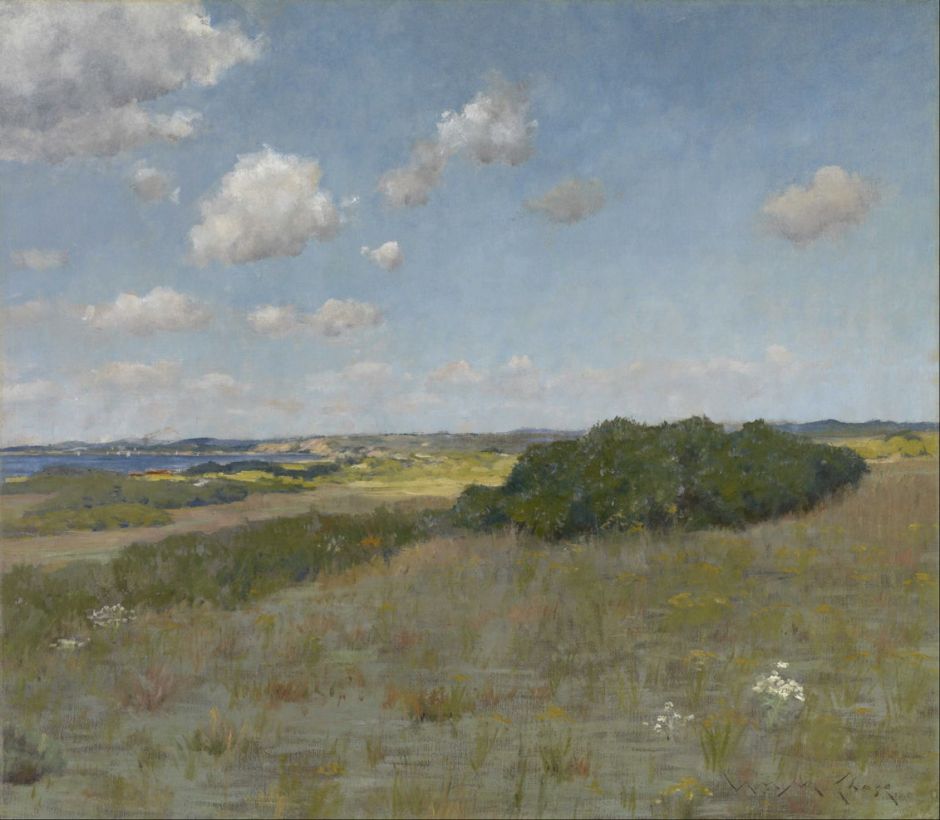
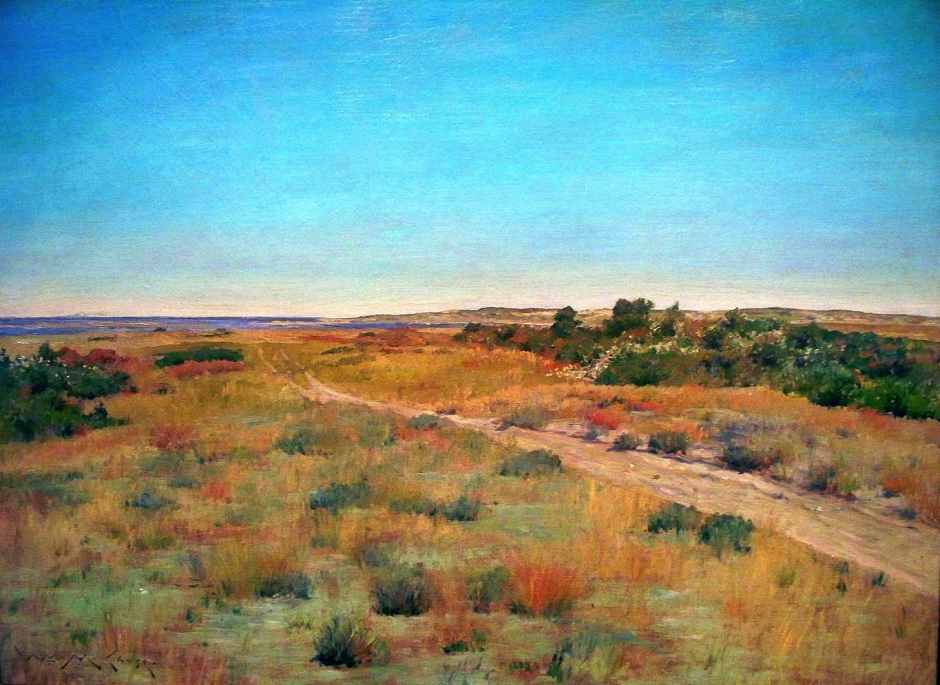
William Merritt Chase Shinnecok Hills Landscape San Diego Museum of Art
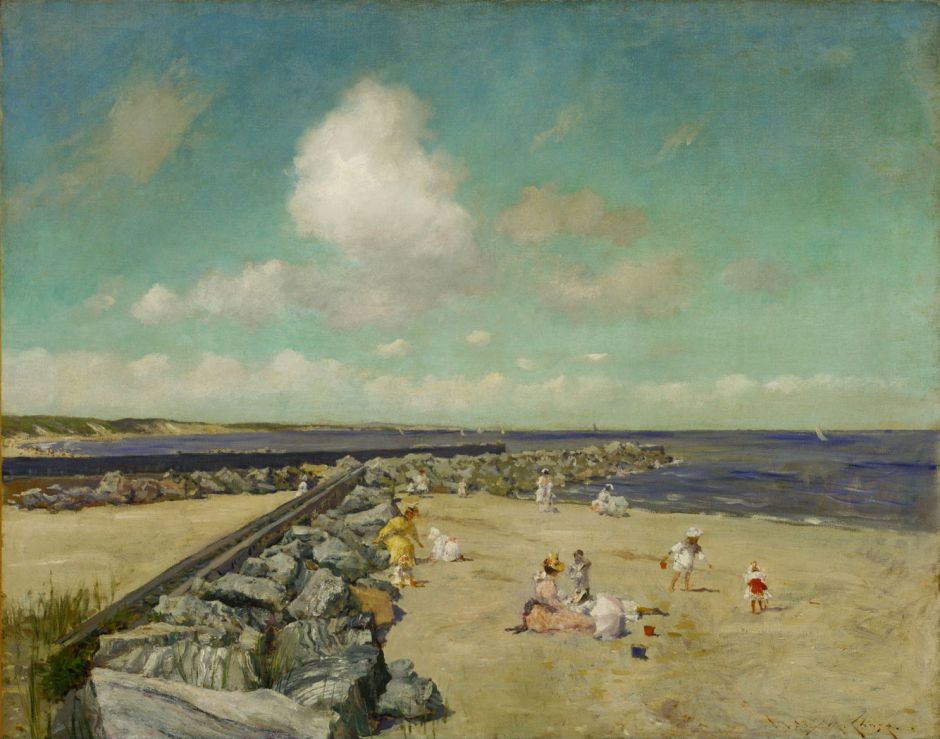
 William Merritt Hunt (1849–1916), Morning at Breakwater, Shinnecock (c 1897), oil on canvas, 101.6 × 127 cm, Terra Foundation for American Fine art, Chicago, IL. Wikimedia Commons.
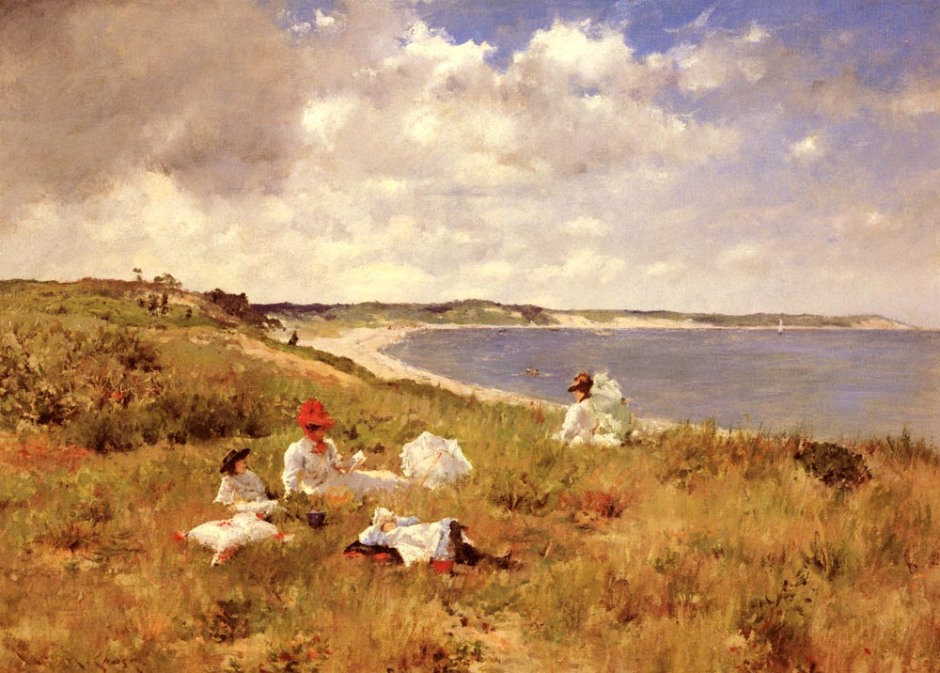
This is the 3rd in the serial of biographical articles to commemorate the centenary of the death of the American Master painter William Merritt Chase (1849–1916). This instalment covers the period from 1891 to 1900, during which the Hunt family spent their summers at Shinnecock on Long Island, where the artist taught at the annual plein air Summer Schools.

By 1891, Chase had a highly successful studio in New York Urban center, an international reputation placing him among the world's leading artists, and a rapidly-growing family living in Greenwich Village. Although he was pedagogy, that remained a relatively small commitment, and his landscape painting was largely express to views of the city parks.
This changed markedly in 1891, when Janet Hoyt invited him to directly her new plein air painting school in the new Art Hamlet in western Southampton, on Long Island. He accepted, and for the first summer moved out of the city to spend the flavor teaching and painting in the Shinnecock Hills.
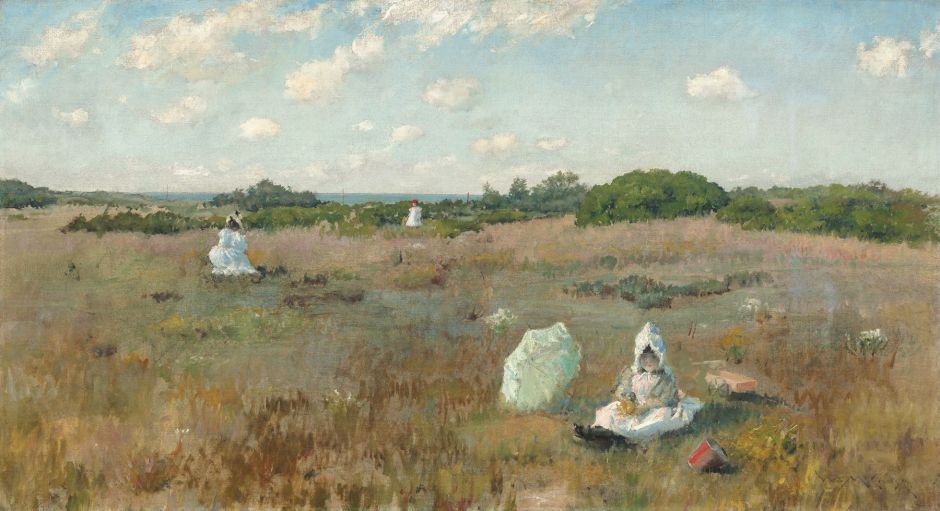
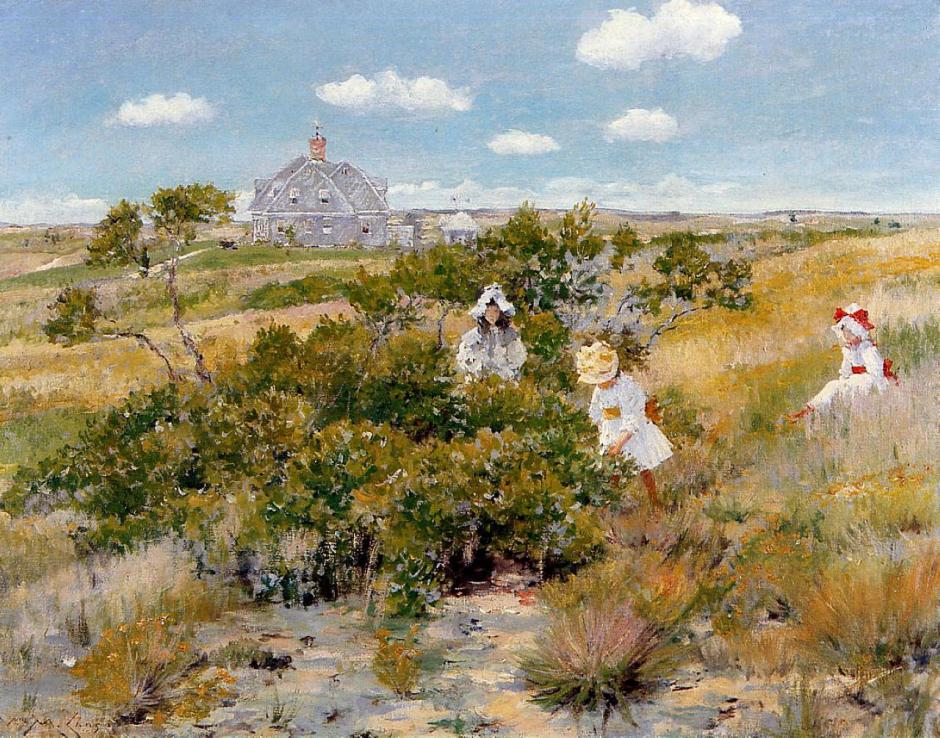
This marked the start of his most productive phase of landscape painting, during which he painted a succession of superb canvases depicting the rough scrub, old tracks, and deserted beaches of the eastern end of Long Island.

His students – here Lydia Field Emmet (1866-1952), who became a leading portraitist in the twentieth century – also proved a steady supply of models for portrait paintings.
Chase seized the opportunity of these Summertime Schools to motility his family out of the city, and deputed his friend Stanford White to pattern a summer domicile for them. This was completed in time for them to use their new business firm in the summer of 1892, when he was dorsum in Shinnecock teaching and painting for his second season.
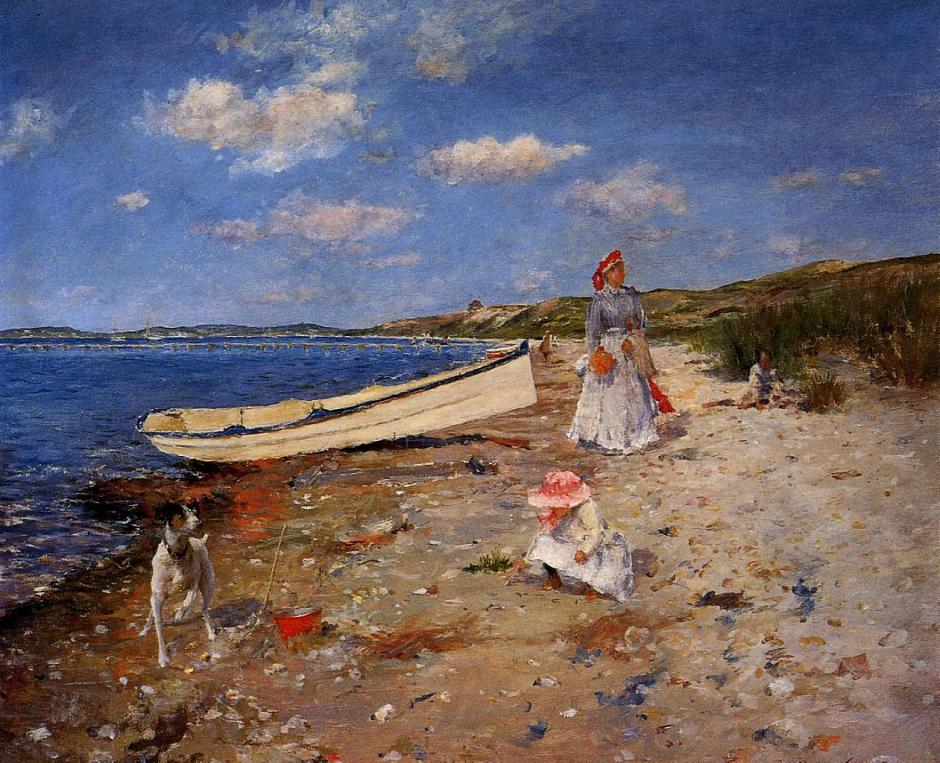
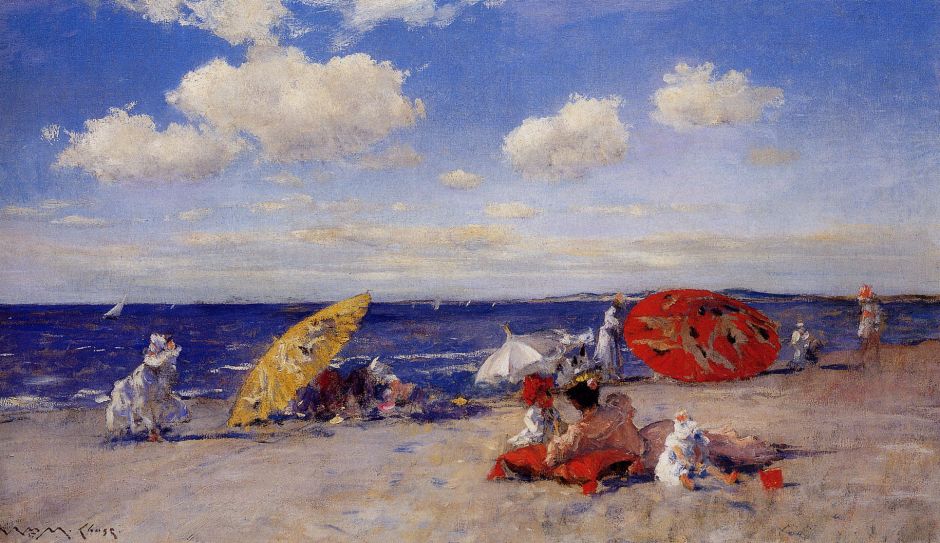
In 1892, he became an instructor to the life class at the Brooklyn Art School, and joined the advisory committee for the 1893 World'south Columbian Exposition beingness held in Chicago.
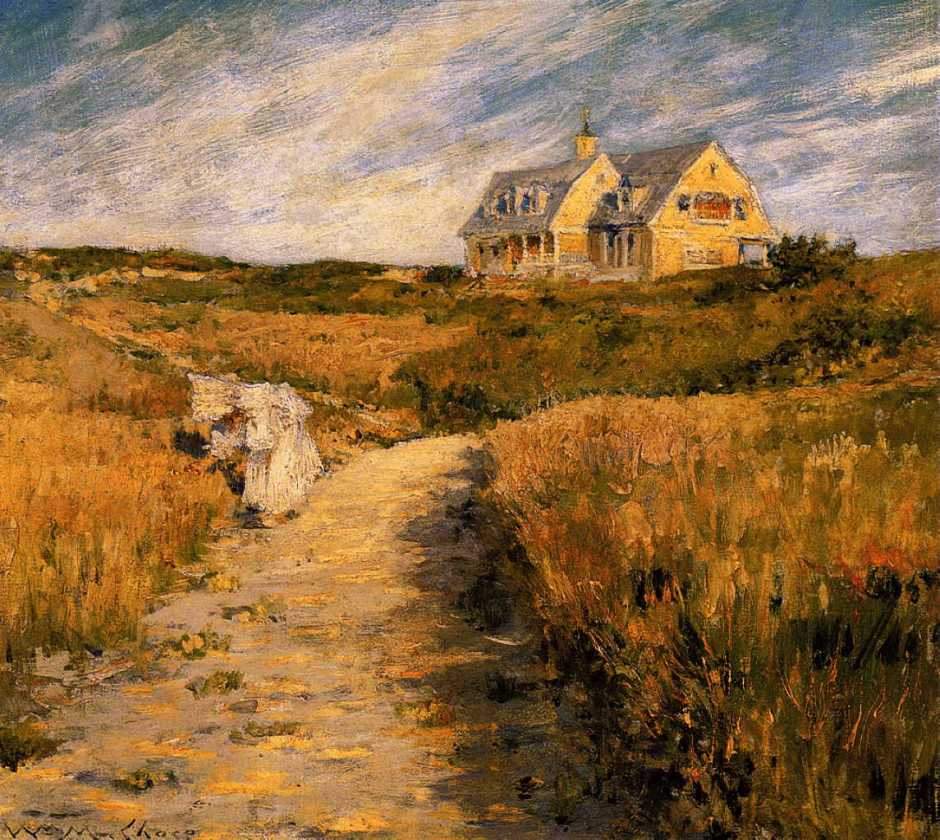
In 1894, the National Academy of Pattern held an exhibition of Portraits of Women, for which six of Chase's paintings were accepted, together with some by John Singer Sargent, and other leading artists.
Chase reviewed his commitments and studio facilities in 1895, and decided that information technology was time to motility on. He closed his Tenth Street Studio, stopped teaching at the Brooklyn Art School, and the whole family unit moved to 234 Due east Fifteenth Street, on Stuyvesant Foursquare at the northern edge of East Village; that was to remain their urban center residence until his death.


The contents of the old Tenth Street Studio were auctioned off in 1896, later on which Hunt, his wife, and two of their daughters took an extended trip to Espana. He taught there in Madrid, and returned in June in time to open the Shinnecock Summer Schoolhouse for another year. While he was decorated with that, he accepted an invitation to teach at the Pennsylvania Academy of the Fine Arts, and in Oct he opened his own schoolhouse, the Chase School of Art, at 106-108 East Twenty-Third Street.
His teaching commitments in 1897 included life classes at the Pennsylvania Academy, the Shinnecock Summertime School, and the kickoff total year running the Chase School of Art.
In 1898, Douglas John Connah (1871-1941) bought the Chase School of Art, and renamed information technology the New York Schoolhouse of Art. Connah had studied art in Weimar, at the Royal Academy in Düsseldorf, and at the Académie Julian in Paris. Chase connected to teach in that location until 1907.
Chase was elected a member of the Plant of Arts and Letters in 1898.

In 1899, Chase served on the national jury for the 1900 Paris Exposition Universelle.

Chase visited the Paris Exposition Universelle in 1900, where one of his portraits won a gilded medal. He also visited Espana briefly, and taught the usual Shinnecock Summer School.
References
Wikipedia
William Merritt Chase: a life in painting, 1, to 1883
William Merritt Chase: a life in painting, 2 1884-1890
In William Merritt Chase's Studio: insights and breezy portraits
Meet the family: William Merritt Chase at dwelling house
Family portraits past William Merritt Chase
Shinnecock summer: William Merritt Chase in the land
Students of Hunt: his greatest legacy
The spontaneous or methodical: Chase and Eakins at work
Prizes, performance and still life
Hirshler EE (2016) William Merritt Chase, Museum of Fine Arts Boston. ISBN 978 0 87846 839 three.
Longwell AG (2014) William Merritt Chase, A Life in Art, Parrish Fine art Museum and D Giles. ISBN 978 1 907804 43 4.
Smithgall E et al. (2016) William Merritt Chase, A Modern Principal, The Phillips Drove and Yale Upward. ISBN 978 0 300 20626 5.
Source: https://eclecticlight.co/2016/10/17/william-merritt-chase-a-life-in-painting-3-1891-1900/
0 Response to "William Merritt Chase Shinnecok Hills Landscape San Diego Museum of Art"
Post a Comment